
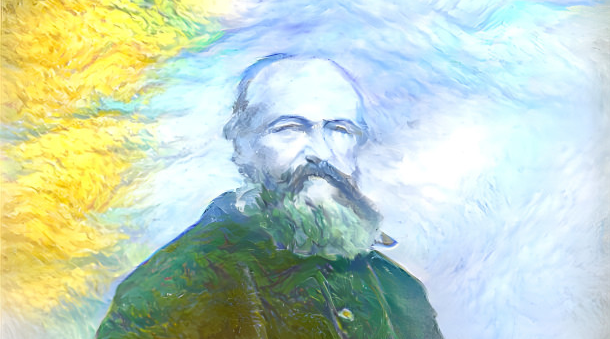
Several dominant cultural themes characterise nineteenth-century France. One was the idea of progress and the belief in the potential for human progress through scientific and technological advancement. This was influenced by the Enlightenment and the French Revolution, which had introduced the notion and the possibility of creating a more just and equitable society. Out of this arose the French Occult Revival. The period is marked by the publication of numerous books on magic as well as the establishment of secret societies and magical orders. A key figure in the revival was Éliphas Lévi (1810-1875), occultist, magician, and writer active in the middle of the century. Perhaps best known for his books on magic, including Dogme et Rituel de la Haute Magie (1854-1856), Lévi’s ideas on the symbolism of the Tarot, however, and its use as a tool for spiritual development, have continued to influence the way the Tarot is understood even today. His legacy has had a significant impact on the development of modern Western occultism.
Lévi emphasised the idea that magic was a form of spiritual and self-transformation and argued that it could be used to achieve a variety of transformative goals. Indeed, by the nineteenth-century, France as a whole was in the midst of significant political and social transformation. The country underwent several major revolutions, including the French Revolution of 1789, the July Revolution of 1830, and the 1848 Revolution. It was a time of significant literary and cultural change. The early years of the century saw the rise of Romanticism, which was characterised by a focus on emotion, individualism, and the power of imagination. French Romantic writers, such as Victor Hugo, Alfred de Vigny, and Gérard de Nerval, were known for their dramatic and passionate works, which often explored love, freedom, and social justice. As the century progressed, France saw the emergence of several other important literary movements, including Realism, Naturalism, and Symbolism. These movements were marked by a focus on social and psychological realism and an interest in exploring the inner lives of its characters. We also see the rise of popular genres such as detective novels and science fiction focused on the hidden, revealed nature of things. Neither Lévi’s audience nor occultism in general were immune to such fashions.
The Hermit:
Fundamental to his system, Lévi describes the existence a universal occult substance that pervades the entire universe and is the source of all psychic and magical phenomena—Astral Light. According to Lévi, the Astral Light was a living, intelligent force capable of responding to the thoughts and desires of human beings. Often referred to by Blavatsky as the ‘Akasha’—a Sanskrit word meaning ‘sky’ or ‘ether’—it was believed to be the medium through which spiritual and psychic communications could be transmitted. Lévi believed that the Astral Light was accessible to those who had developed the necessary spiritual and psychic abilities to perform such magical operations and achieve spiritual enlightenment. Believing that the Astral Light was the source of inspiration for artists and creative thinkers and that it could be accessed through various practices such as meditation, prayer, and ritual, he was also as an advocate of mesmerism, a practice that involves the use of hypnotic techniques, often through the manipulation of gestures, gaze, or suggestion, to induce a trance-like state or altered consciousness in individuals. Lévi believed mesmerism could be used for both therapeutic and spiritual purposes. He described mesmerism as a form of “occult science” and claimed that it could be used to cure physical and mental ailments, as well as to achieve spiritual enlightenment—in true Rosicrucian style. He also believed that mesmerism could be used to communicate with spirits and other supernatural entities and that it could be used to perform the various types of magic.
The Chariot:
Of course, as a key figure in the revival of interest in ceremonial magic and the occult, Lévi’s ideas and writings continue to influence modern occultism. Born in Paris in 1810, Lévi became interested in the occult at an early age. He studied at the Sorbonne and later became a Roman Catholic priest, although he later left the Church and became a member of a masonic lodge. Lévi was interested in the relationship between Freemasonry and the occult. In his writing, he often referred to Freemasonry as a source of occult knowledge and a way to access the universe’s secrets. Lévi believed that Freemasonry, at least at first, was founded on ancient wisdom and contained hidden teachings about the nature of reality. He also argued that Freemasonry’s symbols and ritual practices could be used to tap into the mystical forces of the universe and achieve a state of enlightenment. While Lévi significantly influenced modern Western occultism and magical orders such as the Hermetic Order of the Golden Dawn, his views on Freemasonry were not widely accepted by mainstream Masonic organisations. However, his ideas did have some influence on certain Masonic groups, such as the Ancient and Accepted Scottish Rite vis-à-vis Albert Pike (1809-1891).
Lévi’s concept of magic is based on the idea of a natural and divine force that could be harnessed and used for spiritual and personal development. He believed that magic was a way of accessing and interacting with the spiritual realm and that it could be used to achieve higher states of consciousness and enlightenment. In nineteenth-century France, such utopian ideas were a significant part of the intellectual and political landscape. One of the most influential utopian thinkers of the time was Charles Fourier, who proposed a vision of a utopian society called a “phalanstery,” in which individuals would live and work together in large communities organised according to principles of cooperation and mutual aid. Fourier believed that this type of society would allow people to fully realise their potential and lead more fulfilling lives. Other utopian thinkers in nineteenth-century France included Étienne Cabet, who wrote a book in 1840 called “Voyage en Icarie” (Voyage to Icaria) about a utopian society based on the principles of communism, and Louis Blanc, who argued for the creation of “national workshops” in which the government would provide employment for the poor. These ideas were influential in shaping both the political and social debates of the time, as well the occult.
The Tower:
Socialism emerged as a significant political movement in the late nineteenth-century, particularly in the aftermath of the 1871 Paris Commune, a short-lived revolutionary government that was established in Paris during the Franco-Prussian War. French socialists believed that the government should play a central role in regulating the economy and redistributing wealth to ensure that all citizens had access to education, healthcare, and other necessities. Despite their efforts, French socialists faced significant opposition from the ruling classes and were often met with repression and violence.
There was some overlap between the socialist movement in France and the occult movement in the nineteenth-century, as both were concerned with social and economic inequalities and sought to bring about radical change. Some socialist intellectuals, such as the French anarchist Pierre-Joseph Proudhon (1809- 1865), were influenced by esoteric ideas and saw the occult as a way to access hidden knowledge and understand the underlying forces shaping society. However, the relationship between socialism and the occult was not always straightforward, and many socialists saw the occult as a distraction from the more pressing issues facing society. Some socialists even viewed the occult as a tool of the ruling classes, used to distract and mislead the masses. Despite this, some socialist movements in nineteenth-century France included members who were interested in the occult and saw it as a way to access higher states of consciousness and achieve spiritual enlightenment. These socialists believed that the occult could be a powerful force for social change and that it could help to bring about a more just and equal society.
The Hierophant:
During this time, France was ruled by a series of different governments, including monarchies, republics, and empires. The country also underwent significant economic and social changes, including the Industrial Revolution and the rise of the middle class. Political parties emerged in the nineteenth-century in France, and the country saw the rise of various ideological movements, including liberalism, conservatism, socialism, and nationalism. These movements often had competing agendas and were involved in significant political struggles, including the Dreyfus affair, which was a high-profile scandal that divided the country. The country was undergoing a period of rapid industrialisation, which had a significant impact on the social and economic structure of French society. The growth of industry and commerce led to the emergence of a new class of industrial capitalists, who amassed significant wealth and influence. At the same time, the rise of industry also led to the growth of the working class, as more and more people migrated from rural areas to the cities in search of work. French society was also marked by significant political and social upheaval. The country was still recovering from the effects of the French Revolution, which had taken place several decades earlier, and there were ongoing debates about the role of the state and the nature of democracy. The mid nineteenth-century was also a time of great cultural and intellectual ferment, with the emergence of a number of important artistic and intellectual movements, including Romanticism, Realism, and the fin de siècle.
Overall, French society during the mid-nineteenth-century was marked by a sense of change and uncertainty, as the country struggled to adapt to the rapid pace of industrialisation and the challenges of modernity. Such change and uncertainty allowed mysticism to continue to be an important part of France’s spiritual and philosophical landscape, with several notable figures contributing to its development.
The World:
Éliphas Lévi was an important figure in the history of the Tarot and is credited with helping to popularise the Tarot as a tool for divination and spiritual development. The Tarot has a long history in France and has been popular since at least the eighteenth-century. In the nineteenth-century, the Tarot was particularly associated with the occult and was used by many esoteric practitioners as a tool for divination and self-exploration. Lévi wrote extensively about the Tarot and its symbolic significance. He believed that the Tarot was a powerful tool for understanding the mysteries of the universe and accessing higher states of consciousness. He also believed that the Tarot could be used to predict the future and gain insight into one’s own psyche. The Tarot was also popular among other occultists in nineteenth-century France, including the esoteric author and illustrator Oswald Wirth (1860-1943), who created his own deck of Tarot cards based on Lévi’s ideas.
Lévi provided detailed descriptions of the symbolism of the Tarot and its use in various magical and spiritual practices. Lévi believed that the Tarot was a powerful tool for spiritual development and that it could be used to access the Astral Light, which he described as a universal substance that pervades the entire universe and is the source of all psychic and magical phenomena. He also believed that the Tarot could be used to communicate with spirits and other supernatural entities and that it could be used to perform various types of magic. Lévi’s ideas about the Tarot significantly influenced the development of modern Western occultism and continue to be of interest.
The Devil:
One of the most well-known symbols associated with Lévi is the Baphomet, a depiction of a horned, androgynous figure with a goat’s head. The Baphomet is often associated with Lévi because he included an image of it in his writing. Lévi described the Baphomet as a symbol of the balance and unity of opposites, and he used it to represent the synthesis of opposing forces, such as good and evil, male and female, and spiritual and material. The Baphomet has become a controversial symbol, and its meaning has been subject to much debate and interpretation. Some people have associated it with Satanism or evil, while others see it as a symbol of spiritual awakening or enlightenment. Lévi himself saw the Baphomet as a symbol of the ultimate spiritual attainment and the unity of all things. Lévi included the image in his Dogme et Rituel de la Haute Magie as a symbol of the balance and unity of opposites. However, the Baphomet has taken on a life of its own, and its meaning has been embraced and reinterpreted by many different groups and individuals. The Baphomet is a symbol that has been associated with occultism and theistic Satanism. It is typically depicted as a humanoid figure with the head of a goat and wings, surrounded by flames and symbols such as pentagrams. The symbol has a complex and controversial history, and it has been variously interpreted and used in different contexts. In the political sphere, the Baphomet has sometimes been invoked as a symbol of resistance or rebellion against authority or mainstream values. For example, it has been used by some groups as a symbol of their opposition to organized religion or to the perceived influence of religion in politics. However, the Baphomet has also been used in a more sinister manner, such as by extremist or hate groups as a symbol of their ideology or to promote violence or discrimination. In some cases, the Baphomet has been appropriated by these groups for the purpose of spreading fear or inciting violence against minority groups.
One aspect of the Baphomet that has received particular attention is its association with sexuality. Some interpretations of the symbol associate it with sexual liberation and the rejection of traditional notions of sexual morality. In this context, the Baphomet may be seen as a symbol of resistance to societal norms and expectations around sexuality. Other interpretations of the Baphomet, however, have focused on its association with sexual deviance or perversion. In some cases, the Baphomet has been depicted as representing sexual depravity or promiscuity, and it has been used by some groups to promote or glorify sexual practices that are considered taboo or abnormal. The Baphomet is a complex and multifaceted symbol that has a rich and varied history. Its use in politics can vary widely depending on the context and the intentions of those who invoke it—none of which were intended by Lévi’s himself.
The Hanged Man:
The concept of occultism, which refers to practices and beliefs that are considered to be hidden or secret, has a long history and has been a source of fascination for many people throughout the centuries. Today, the term “occult” is often used to refer to a wide range of practices and beliefs that are considered to be outside the mainstream, including magic, alchemy, tarot, astrology, and various forms of spirituality and alternative healing. Some people view occult practices and beliefs as an important part of their personal spiritual journey and find them to be a meaningful and enriching aspect of their lives. Others may view occultism with scepticism or even hostility and may see it as having little or no value. Despite this, magic continues to be a source of fascination and inspiration for many people, and it is practiced by a diverse group of individuals around the world. Lévi’s writings had a significant influence on the development of the occult and esoteric traditions in the nineteenth century. He was one of the first writers to systematically explore and codify the various practices and beliefs associated with these traditions, and his works helped to popularize and spread interest in these subjects. Lévi’s ideas and concepts have been adopted and adapted by numerous writers, artists, and practitioners of the occult and esoteric traditions, and his works have been translated into several languages, making his ideas widely available to readers around the world.
Indeed, Lévi’s poetry has recently been translated by the author and is available to buy here: https://amzn.eu/d/1c73Yp0
 Stewart Clelland