
kist (noun)
- (Scots) A chest, box, or coffer—traditionally wooden—used for storing clothes, valuables, or household items.
gauze (noun)
- A thin, translucent, loosely woven fabric, used especially for medical dressings and bandages.
— Etymology: Possibly from the Arabic Ghazzah (غَزَّة), the name of Gaza, a city historically associated with the production of fine, delicate fabrics.
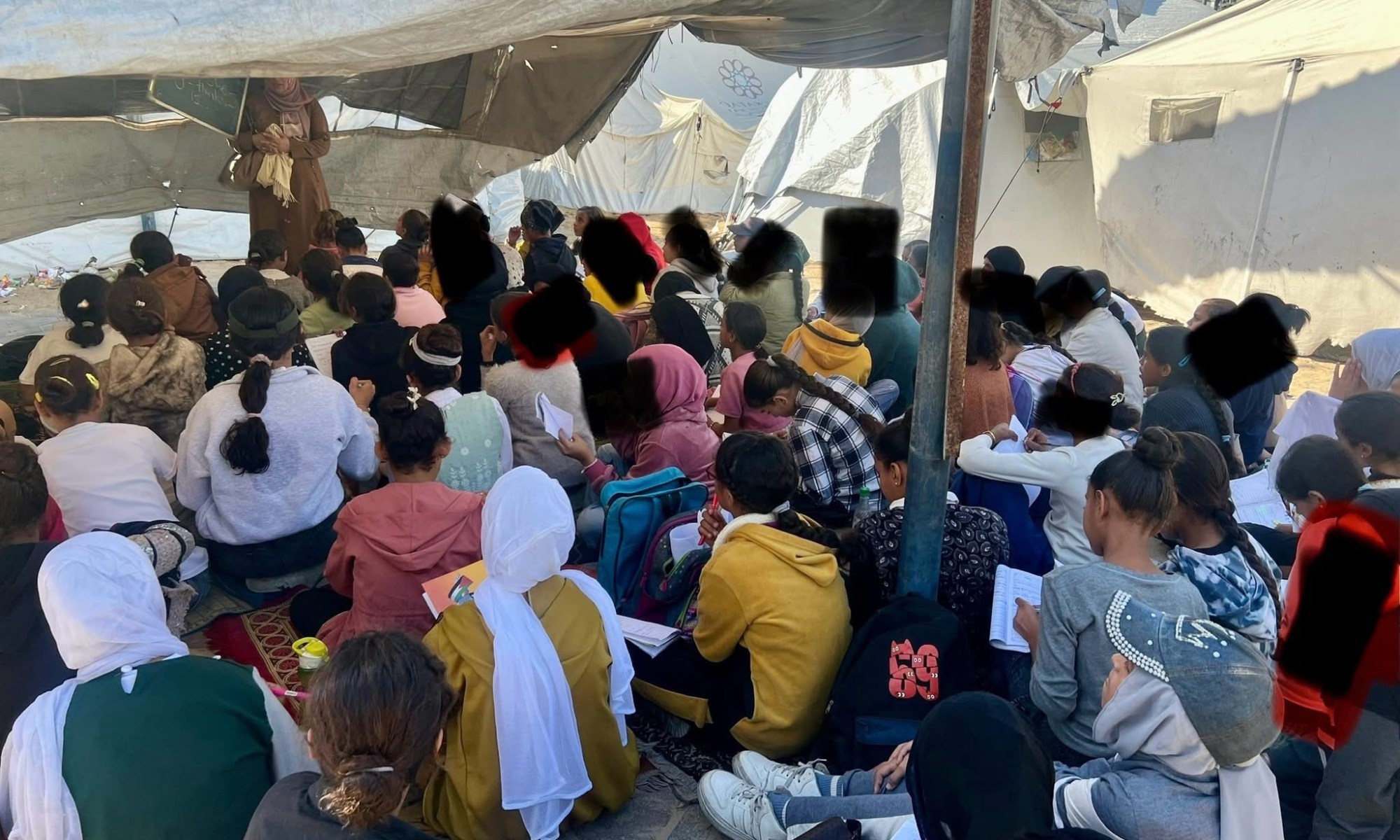
Reflecting on the cross-cultural letter exchange I facilitated (linking Palestinian pupils in Gaza with Scottish learners writing in Scots and Doric) I have come to understand the project as a profoundly dialogic and emancipatory pedagogical act. Situated within a Freirean tradition of critical pedagogy and informed by Jacques Derrida’s post-structuralist thought, the exchange disrupted what Gogolin (2002) describes as the “monolingual habitus,” the pervasive assumption that privileges Standard English within Scottish education (Macafee, 1994; Gibson & Gifford, 1997). Freire (1970) asserts that authentic education arises through dialogue between subjects, grounded in humility, love, and justice. The letter exchange embodied this philosophy. Rather than positioning Palestinian pupils as distant others, the project established a shared communicative space—a kind of collective kist—in which young people from different geopolitical backgrounds could store, uncover, and exchange their lived experiences.
This approach supports Freire’s (1970) argument that dialogue extends beyond conversation; it enables learners to perceive the world as collectively shaped and open to transformation towards freedom and equality. In this sense, the kist became both a pedagogical tool and a theoretical metaphor, resisting linguistic homogenisation and affirming the value of diverse narrative inheritances. The project invited all participants ‘to lift the lid’ together, to look inside, to contribute, to question, and to learn. It foregrounded the idea that every learner brings with them a storehouse of meanings, memories, and linguistic resources, all of which are worthy of recognition.
By responding in Scots and Doric, my pupils participated in what Freire (1970, 76-77) describes as “reclaiming voice.” They utilised their own linguistic and cultural resources to express empathy and solidarity. This approach directly opposes the “banking model” of language learning, which marginalises non-dominant varieties (Freire, 1970, 72). In this context, the lesson positioned Scots not merely as a medium for humour or informal speech, but as a language capable of conveying moral imagination and ethical connection. This shift addresses the deficit narratives internalised by Scottish pupils, such as the “Scottish cringe,” and reinforces Freire’s argument that oppressive cultural assumptions must be critically examined for learners to realise their full humanity.
The letters from Gaza conveyed significant emotional content, including testimony, trauma, resilience, humour, and hope—held delicately together like fine gauze. These served as “generative themes” (Freire, 1970, 87) that enabled my pupils to confront global injustice and reflect on their own positionality. For example, Phoebe’s discovery of a shared interest with Hanan in Korean language and culture exemplified Freire’s (1970, 125) concept of “unity in diversity,” demonstrating that humanisation emerges from recognising one another across differences rather than erasing them.
The project’s multilingual dimension, incorporating Arabic, Scots, English, and Korean, reflects Derrida’s (1978) critique of linguistic purity. Employing multiple languages in the classroom demonstrated the instability of linguistic boundaries, supporting Giannini’s (2024) claim that multilingualism is the global norm. For my pupils, writing in Scots became an act of resistance, rejecting traditional language hierarchies and moving toward what Bourdieu (1991, 43) describes as a “symbolic reconfiguration” of linguistic capital. Here again the gauze metaphor holds: Scots, often dismissed as coarse or unsuitable, proved capable of carrying profound emotional weight when woven into this intercultural exchange.
This project directly addressed tensions within Scots-language pedagogy, particularly the perception among pupils that Scots is unsuitable for serious expression (Niven, 1998; Shoba, 2010). By centring Scots within a high-stakes, emotionally significant task, I enabled pupils to reconsider their language’s value. The exchange facilitated what post-structuralists term the rupture of fixed linguistic categories and contributed to processes of “subjectification” (Biesta, 2006, 27), allowing learners to develop new ethical, relational, and linguistic capacities—carefully woven, like the finest threads, into a shared future. Like gauze, these threads remain open, breathable, and in motion, yet collectively strong enough to hold the possibility of healing and regrowth.
Biesta, G. (2006) Beyond Learning: Democratic Education for a Human Future. Boulder: Paradigm.
Bourdieu, P. (1991) Language and Symbolic Power. Cambridge: Polity Press.
Derrida, J. (1978) Writing and Difference. London: Routledge.
Freire, P. (1970) Pedagogy of the Oppressed. New York: Continuum.
Gibson, H. and Gifford, D. (1997) ‘Attitudes to Scots’, in Jones, C. (ed.) The Edinburgh History of the Scots Language. Edinburgh: Edinburgh University Press.
Giannini, S. (2024) ‘International Mother Language Day: UNESCO Statement’. UNESCO.
Gogolin, I. (2002) ‘The Monolingual Habitus’, European Educational Research Journal, 1(2), 177–186.
Macafee, C. (1994) Traditional Dialect in the Modern World. Frankfurt: Peter Lang.
Niven, L. (1998) ‘Parents’ Views of Scots Language in Education’, Scottish Language, 17, 52–68.
Shoba, J. A. (2010) ‘Scottish Classroom Voices: A Case Study of Teaching and Learning Scots’, Language and Education, 24(5), 385–400.
 Stewart Clelland